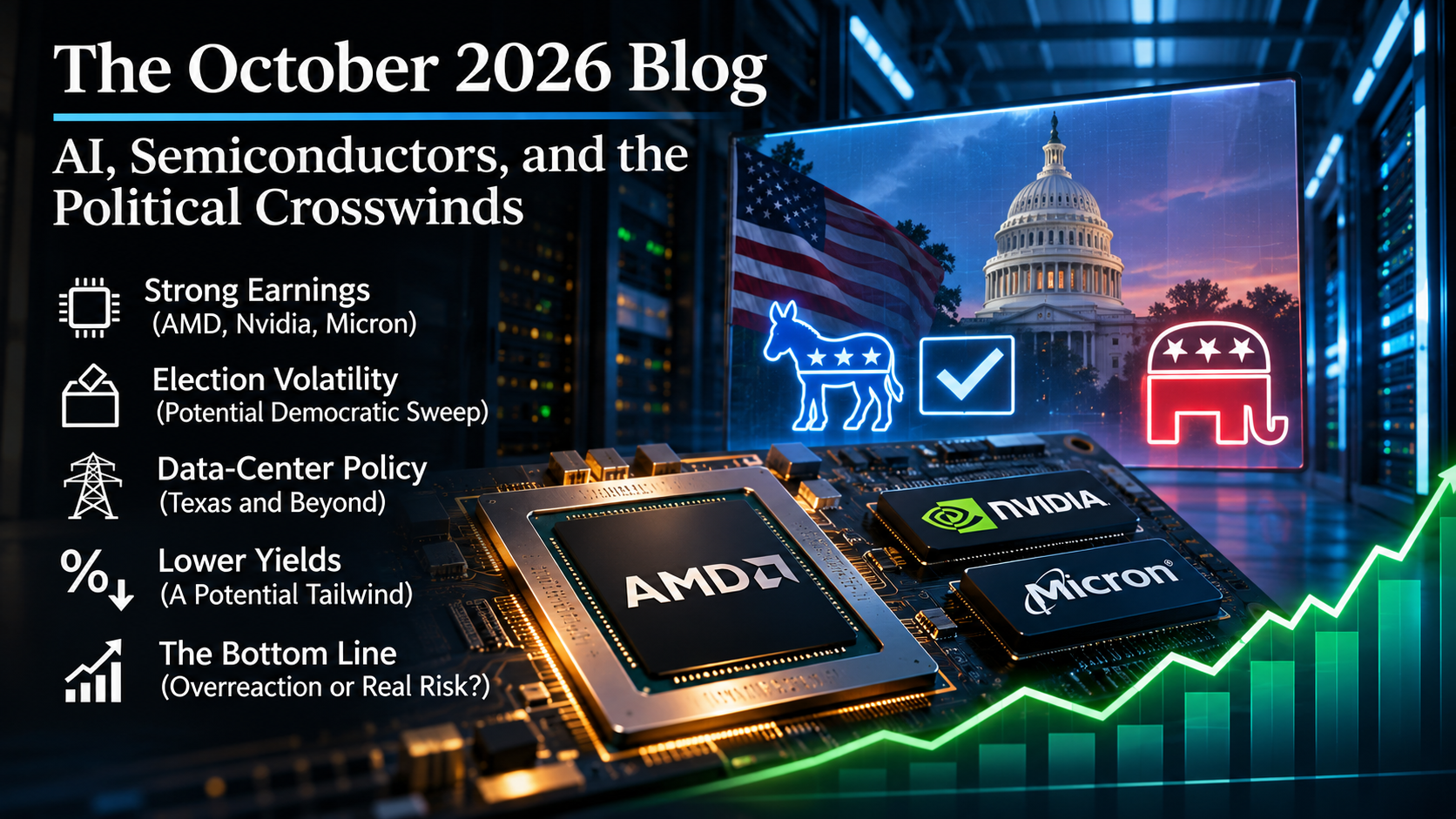
October 2026 Market Recap: Tech Corrects as AI Valuations Reset
October tested investors’ confidence in the durability of the AI investment cycle. The S&P 500 declined 0.87%, while the Nasdaq 100 fell approximately 6.94% and the VanEck Semiconductor ETF (SMH) lost roughly 15.43%. At the same time, the Bloomberg U.S. Aggregate Bond Index gained 2.05%, reflecting lower Treasury yields and a rotation toward risk off assets. The divergence was striking: weakness was concentrated in technology and semiconductors rather than uniformly distributed across asset classes.
The underlying debate was not simply whether AI demand remained strong. Corporate earnings continued to point to substantial infrastructure investment, but investors increasingly questioned how that spending would be financed, when it would translate into sustainable returns, and whether elevated semiconductor profitability could persist. Meanwhile, renewed inflation concerns, softer employment data and uncertainty surrounding Iran complicated the macroeconomic backdrop.
A Softer Labor Market Meets Persistent Inflation
The September employment report, released by the U.S. Bureau of Labor Statistics on October 2, showed just 29,000 new nonfarm payrolls versus expectations for 85,000. August payrolls were revised lower, from 162,000 to 133,000. The S&P 500 declined approximately 70 basis points following the release (data per S&P Dow Jones). Although other indicators suggested the economy retained some resilience, the slowdown in hiring introduced a new concern: labor-market weakness could become more pronounced before inflation returns to a comfortable level.
Inflation provided little relief. September consumer prices, reported by the U.S. Bureau of Labor Statistics on October 14, rose 3.7% year over year, above the 3.6% Dow Jones consensus estimate. Producer prices, reported the following day by the U.S. Bureau of Labor Statistics, increased 6.3% year over year versus Dow Jones estimates for 5.3%. Equities declined across the two releases as investors reassessed the Federal Reserve’s flexibility (data per Yahoo Finance). The combination of softer hiring and persistent price pressures presents a difficult dilemma for the Federal Reserve as the continue to weigh the timing and extent of additional rate hikes.
Iran, Energy Prices and the Path of Interest Rates
Geopolitical developments remained an important driver of inflation expectations. Renewed U.S.–Iran tensions heightened concern about oil supply and shipping through the Strait of Hormuz. However, on October 25, both sides signaled a pause in escalation and a willingness to resume discussions. That helped ease immediate market anxiety, although crude oil remained above $100 per barrel as of 10/25/26 (data per Yahoo Finance), indicating that investors were not yet anticipating a full normalization of energy flows.
We believe a lasting reduction in tensions will likely have meaningful economic consequences. Lower energy prices could ease headline inflation, reduce pressure on businesses and consumers, and give the Federal Reserve reason for a continued pause in raising rates. However, the durability of any diplomatic progress remains uncertain, and further escalation could quickly reverse that benefit.
Treasury Yields Retreat as Investors Reduce Risk
Despite the upside inflation surprises, treasury yields moved lower during the month of October as investors shifted toward bonds. The 10-year Treasury yield had eclipsed approximately 5.3% to start the month (10/1/2026, data per Yahoo Finance), a level that made fixed income increasingly competitive with equities and placed additional pressure on longer-duration growth valuations. The rally in bonds offered a counterweight to equity weakness, but it also highlighted how quickly investor positioning can change when confidence in technology leadership deteriorates.
On October 28, the Federal Reserve voted 10–2 to hold interest rates steady. Policymakers emphasized the importance of assessing broader economic trends rather than reacting to isolated releases, while acknowledging tighter financial conditions after September’s rate increase. In our view, the Fed does not appear eager to tighten again immediately, but persistent inflation and geopolitical uncertainty leave another increase in December possible.
Technology Earnings Reveal Both Strength and Investor Skepticism
October’s earnings season presented an increasingly complicated picture. SpaceX reported substantial revenue and earnings beats on October 20, with improving profitability in its “Super Intelligence” division offering evidence that some large AI investments are beginning to produce meaningful returns. Tesla and Meta followed on October 21. Both exceeded earnings expectations, although their spending outlooks diverged: Meta raised the lower end of its capital-expenditure guidance, while Tesla reduced planned spending. We view the latter as more company-specific than evidence of a broad retreat from AI investment.
Microsoft and Alphabet reported October 28. Microsoft exceeded revenue and earnings expectations, supported by cloud growth and signs of AI monetization, while remaining free-cash-flow positive despite substantial infrastructure spending. Alphabet missed revenue and earnings expectations, and heavy cloud investment alongside investments in SpaceX and Anthropic weighed on reported results and free cash flow. The contrast underscored investors’ growing attention to the timing and financing of AI returns.
The following day brought a similarly mixed set of reports. Amazon missed revenue and earnings expectations and reported negative cash flow amid elevated AI-related investment, while maintaining its capital-spending outlook. Intel exceeded earnings expectations but offered weaker guidance tied to softer PC demand; data-center and AI revenue remained a relative bright spot. Sandisk, by contrast, beat revenue and earnings estimates and issued stronger-than-expected guidance, citing additional long-term customer agreements with creditworthy counterparties.
Memory Demand Challenges the Traditional Cycle Narrative
Sandisk’s results were especially notable because they reinforced the argument that memory demand may be more durable than investors currently assume. Long-term customer agreements can improve visibility into future production and demand, potentially reducing some of the volatility that has historically characterized the memory industry. That does not eliminate cyclical risk: contract economics, pricing adjustments and eventual supply additions still matter. But it complicates the assumption that today’s elevated profitability must inevitably reverse on the timetable of prior cycles.
The contrast between operating results and share-price performance was stark. Semiconductor equities experienced severe multiple compression during October even as selected companies continued to report strong demand and forward guidance. In our view, investors are increasingly differentiating between the near-term need to finance AI infrastructure and the longer-term potential of that infrastructure to generate productivity gains and earnings growth. So, we believe it’s less about whether and to what extent companies continue to invest in AI infrastructure (they’ve made their intentions clear through cash burn and debt financing) and more about whether it will pay off. Investment in AI infrastructure is not going anywhere any time soon. It’s just a question of which companies can sustain and justify those investments and for how long. Ultimately, winners and losers on both sides will shake out, and that’s what we believe the market is currently trying to assess.
Consumer Earnings Suggest Continued Resilience
Outside technology, Coca-Cola and Visa reported on October 27 and exceeded both revenue and earnings expectations. Coca-Cola increased its full-year revenue outlook, while Visa offered somewhat softer guidance. Together, the reports suggested that consumer spending remained relatively resilient despite inflation and elevated borrowing costs. This distinction matters: the broader economy has not necessarily weakened to the same degree implied by the sharp correction in AI-related equities. Of course, this is something we will continue to monitor as inflation continues to seep into the broader economy.
AI Investment: Near-Term Inflation Risk, Long-Term Productivity Opportunity
Taken together, the earnings reports suggest that AI infrastructure spending remains substantial and may continue to grow. The central question is whether companies can finance that investment and demonstrate monetization quickly enough to satisfy investors. Building data centers and deploying advanced computing systems also requires energy, equipment, semiconductors, construction and labor. In the near term, that demand may add to inflationary pressures and complicate monetary policy.
Over a longer horizon, however, successful AI deployment could improve productivity and exert a moderating influence on costs. We believe the market is navigating this tension in real time: companies exposed to AI infrastructure can report exceptional growth while still experiencing steep stock-price declines if investors become less willing to capitalize future earnings at elevated multiples.
Looking Ahead: A Test of Fundamentals Versus Sentiment
October’s market action leaves investors confronting two competing narratives. The macroeconomic environment remains challenging, with sticky inflation, geopolitical uncertainty and elevated borrowing costs. At the same time, many AI-related businesses continue to report robust demand and meaningful investment commitments. The recent selloff suggests investors are assigning greater weight to financing risk and earnings durability than to the immediate strength of reported results.
We believe the coming months will be particularly important for assessing whether this is primarily a valuation reset or the beginning of a more consequential change in fundamentals. Continued strength in semiconductor demand, stable forward earnings expectations and greater clarity on AI monetization would support a more constructive outlook. Progress toward a resolution with Iran, along with reduced uncertainty following the midterm elections, should also improve sentiment.
For now, selectivity and disciplined risk management remain essential. The opportunity may lie in distinguishing businesses with durable cash flows and credible long-term demand from those whose valuations depend on optimistic assumptions about future AI returns. October demonstrated that even strong fundamentals do not immunize securities against sharp changes in investor expectations. For now, we remain cautiously optimistic on equities, particularly given the opportunity their recent sell off has provided relative to expected earnings growth.
Disclosure
The S&P 500 (Standard & Poor's 500) is a stock market index tracking the performance of roughly 500 leading U.S. publicly traded companies, representing about 80% of the total U.S. market capitalization.
The Bloomberg US Aggregate Bond Index (often called "the Agg") is a broad-based, market-capitalization-weighted benchmark measuring the performance of the US dollar-denominated, investment-grade, fixed-rate taxable bond market.
The reader should not assume that investment decisions identified and discussed were or will be profitable. Specific investment advice references provided herein are for illustrative purposes only and are not necessarily representative of investments that will be made in the future.
*This document does not constitute advice or a recommendation or offer to sell or a solicitation to deal in any security or financial product. It is provided for information purposes only and on the understanding that the recipient has sufficient knowledge and experience to be able to understand and make their own evaluation of the proposals and services described herein, any risks associated therewith and any related legal, tax, accounting or other material considerations. *
Certain information contained herein has been obtained from third party sources and such information has not been independently verified by Global Beta Advisors (“Global Beta”). No representation, warranty, or undertaking, expressed or implied, is given to the accuracy or completeness of such information by Global Beta or any other person. While such sources are believed to be reliable, Global Beta does not assume any responsibility for the accuracy or completeness of such information. Global Beta does not undertake any obligation to update the information contained herein as of any future date.
Except where otherwise indicated, the information contained in this presentation is based on matters as they exist as of the date of preparation of such material and not as of the date of distribution or any future date. Recipients should not rely on this material in making any future investment decision.
Certain information contained herein constitutes “forward-looking statements,” which can be identified by the use of forward-looking terminology such as “may,” “will,” “should,” “expect,” “anticipate,” “project,” “estimate,” “intend,” “continue,” or “believe,” or the negatives thereof or other variations thereon or comparable terminology. Due to various risks and uncertainties, actual events, results or actual performance may differ materially from those reflected or contemplated in such forward-looking statements. Nothing contained herein may be relied upon as a guarantee, promise, assurance or a representation as to the future.
The results discussed herein are derived from both quantitative and qualitative factors, including historical returns and market conditions and assumptions. The projected results are presented to establish a benchmark for future evaluation of its performance, to provide a measure to assist in assessing the anticipated risk and reward characteristics of an investment to facilitate comparisons with other investments. Any target data or other forecasts contained herein are based upon highly subjective estimates and assumptions about circumstances and events that may not yet have taken place and may never do so. If any of the assumptions used do not prove to be true, results may vary substantially. The projected investment returns are pre-tax and represent possible returns that may be achieved. The projected investment returns are subject to change at any time and are current as of the date hereof only. In any given year, there may be significant variation from these projections, there is no guarantee that they will be able to achieve the projected investment returns in the short term or the long term.
The results contained herein are for illustrative purposes only, do not represent the performance of any Global Beta Advisor’s Artha product or any particular investment, and are not intended to predict or depict future results. Performance does not reflect the deduction of fees or expenses, returns received by an investor would otherwise be lower.